Where does work get stuck in your company?
One bottleneck and the structure that keeps producing it.
We find the spot where work gets stuck in your company, and for that we look at organisation, workflow and IT at the same time. You get one diagnosis and a measurement that shows you at any time where the bottleneck sits.
Free, 30 to 60 minutes: first ideas and an honest assessment of whether we can help.
Lead time from 20 days to 5, measured across the entire value stream (Energy). Read the full case
How it works
From the first call until it runs
- 1
First call
free, 30 to 60 minutesYou tell us where things are stuck. You get first ideas you can try right away, and an honest assessment of whether we can help you. If we can't, we tell you.
- 2
Measure
We measure where the work gets stuck and lay the org chart, the process map and the system landscape on top of each other. That is where we look for the cause.
- 3
Change it together
We change what holds the work up, in the organisation, the workflow or IT. We only leave once it runs without us.
„An hour lost at a bottleneck is an hour lost for the total system. An hour saved at a non-bottleneck is a mirage.“
— Eliyahu M. Goldratt
The line comes from “The Goal”. Goldratt developed the Theory of Constraints. It is our method.
Basics
The principle in four building blocks
How the three foundations work together.
The method: Theory of Constraints
Every system has at least one constraint, and it determines how much the whole system delivers. Usually it is a policy: an ownership, an approval, a metric. We find it, look for its cause, get everything we can out of it, line everything else up behind it, and elevate it only if that pays off.
The principle: people and technology together
Organisation, process and IT form one system. Socio-technical systems theory calls this joint optimisation: improve only the people or only the technology and you get a worse whole. That is why we look at all three at once.
The test: Conway’s Law
A system an organisation builds itself mirrors its communication structure. Change only the organisation and IT pulls you back, and vice versa. And where ownership and system boundaries don’t line up, there is friction. Friction is a candidate for the bottleneck. Whether it is one, the measurement decides.
The consequence
We name no bottleneck before we have laid the org chart, the process map and the system landscape on top of each other. The same people look through all three in the same week and give one single diagnosis. Then you decide whether we elevate the bottleneck. Sometimes it pays more to leave it where it is and use it fully: a known bottleneck makes the whole system predictable and controllable.
In a picture
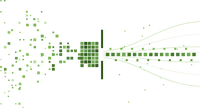
The principle in one picture
Services
Organisation, workflow, IT
For us these are not three offerings. They are the same decision, just with different costs of change: you change a responsibility faster than a workflow, and a workflow faster than an architecture. Take the decisions one after another and you pay for every correction where it is most expensive.
Come with the topic that hurts right now. We still look at all three, because a bottleneck often shows up in one layer and has its cause in another.


Common mistakes
What happens when you pull at one corner only
Three patterns we see again and again.
 Each of these patterns appears when one layer is touched and the other two are left alone. An example from one of our projects: the lead time was 20 days. It showed up in the workflow: every configuration waited for several departments that had to sign off one after another. The cause lay in the organisation: the agile operating model had changed the teams, but the approvals had stayed in the old line organisation. Read the full case →
Organisation only
Reorg carousel
New boxes, same waiting times. The org chart looks better, the customer waits just as long.
Process only
Method theatre
The framework is rolled out, the board is green, everyone is busy. Still nothing ships, because the ceremony has replaced the workflow.
IT only
Distributed monolith
Microservice invoice at monolith speed. The same entanglement, now across the network and more expensive.
Why us
Why not …?
Why not an agile coach?
A coach brings a framework and introduces it. We start with the diagnosis. Whether a framework helps afterwards, and which one, is only decided once it is clear where the work waits.
Why not an architecture consultancy?
A new architecture only helps if the architecture is the bottleneck. We measure that first. Usually it is not.
Why not a big consulting firm?
There, different practices often look at organisation, process and IT one after the other. With us, the same people look through all three in the same week and give one diagnosis. There is no handover in between.
Why not a freelancer?
One person usually sees one layer. The bottleneck often shows in one and has its cause in another.
This is why we do not sell a method
Frameworks are toolboxes, not diagnoses.
A bottleneck is always yours. It grows out of your structure, your market and your history. No method can know it before it has been to your place.
- We pick what fits the bottleneck: SAFe, LeSS, OKR, Flight Levels, Kanban, ITIL, Lean, BPMN, Theory of Constraints.
- We know the frameworks well enough to spot when they are the wrong tool.
Current
A current example: AI
Coding faster only helps if coding is the bottleneck.
- A tool on an unchanged process: in a controlled study, experienced developers using AI tools became 19 % slower and still believed afterwards that they had been faster.

Where is your bottleneck?
The Montags-Check shows you in 2 to 6 weeks: where the work waits, why, and what a first trial at the bottleneck brings.
To the Montags-Check